|
| My non-toxic carpet spot cleaners |
I was asked a great question this week, and thought I’d share it and my answer with y’all.
QUESTION:
I’ve been doing a lot of reading about the different ways toxins get
into our lives and the healthier alternatives. It’s rather overwhelming
as I’m sure you know! Although I’d love to implement many of them, we
are not going to spend a lot of money on it, so I am trying to
prioritize what would be the most important areas to change. For
example, would it be better to put money toward things that bother me,
like a filter for our chlorinated tap water, or to buy natural body care
products or organic foods or replace aluminum cookware,etc? We may do
all of the above mentioned things eventually, but right now I’m trying
to figure out if certain things are more likely to be problematic and
should be addressed first.
ANSWER:
I totally understand your prioritizing question and went through that myself…still going through that a little. There isn't a clear cut answer, and certainly there is no "right" way to go about it. Any improvement is helpful. Most importantly, just take it one step at a time!
The way I determine what to do first is:
1. A balance of cost and benefit, and if it’s one time or ongoing
(e.g. organic foods are a substantial ongoing cost vs. replacing aluminum
cookware, one time cost. Personally, I’d be tempted to delay organic
produce for a bit and save that money to buy a water filter or stainless
steel/cast iron/stone cookware).
2. Level of toxins for each. This is hard to determine, different
toxins affect people differently. However, in looking at organic foods,
you may choose to buy organic apples since they are in the top dozen of
most pesticides, etc and buy conventional avocados, since almost no
chemicals are used on them anyway. Or replacing
toxic surface cleaners/disinfectants (you breath them 24/7 and touch
those surfaces a lot) before buying organic bananas (not on the dirty
dozen list and has a thick peel which helps some).
3. Just do one thing at a time, then the next, and before you know it
you will have converted most of your stuff. I know it’s easy to panic
and want to do it all at once, but slow and steady does win the race.
This one is a marathon, not a sprint!
How I would Prioritize Going Non-Toxic
1. Water filter
2. Household cleaners, laundry detergents, air fresheners, etc (this
ranks high - afterall, we have to breath this stuff 24/7, and little
feet and hands touch and absorb it. It’s also relatively easy to
transition.)
3. Natural body care products that stay on your skin or are cheaper than conventional.
4. Organic oils, meats, eggs. (This could easily be higher on the list, it’s a toss up in my book.)
5. Cookware (replacing aluminum, copper, non-stick and Tephlon)
6. Other
body care products and other top priority
organic foods
7. Food Storage (replacing plastic with glass)
Explaining My Choices
Of these items, a water filter and cookware are mostly one time
costs; where body care products, cleaners and organic foods are ongoing
costs. So, I would list the one time cost items in order of priority,
and do the basic minimums (as money allows) on the ongoing items
alongside of that.
Water Filter
Without a doubt, I would get a water filter first,
and not just a chlorine filter, but one that takes out fluoride,
pharmaceuticals, heavy metals, VOC’s (volatile organic compounds, I
think) etc. We drink water a lot, it’s obviously very essential to the
body. We’re made of mostly water! It’s extremely important to our health
to have pure water. There are tons of different types of filters
available. Personally, we decided to get a Reverse Osmosis (RO) system
that mounts under the sink. It seemed the best balance of cost, purity,
and ease/convenience of install and use. The prices vary greatly, as
does the quality and most expensive ones are not necessarily the best.
We got ours from Costco for around $200. I know Sam’s Club has them too.
And replacement filters (every 6 months) run around $50. My husband is
quite a handyman and installed it himself, so there was no plumber cost.
The rest of the conversion options aren’t as clear cut.
Natural Body Care Products
I would switch to natural body care products
as I used up the conventional ones, and spread out the initial
change-over cost over time that way. And, you can do things like
switching to natural bar soap instead of using liquid soap. The natural
liquid soaps are really expensive, but the bar soaps are cheap and long
lasting, so I actually spend less now on soap than I did before I went
nontoxic! I do get liquid soap (nontoxic, but not organic) for the
kitchen though. And here you really have to think through how you use
products and where to spend money. Personally for kitchen soap, it’s on
my hands briefly and I wash it right off, so I just get something real
basic, not the best. Now lotion, where I rub it on and it soaks in (so
some of it ends up in my blood fairly quickly without the slight
benefits of filtration through the digestive system) I’m willing to
spend a little more. Make up falls in this category as well!
Non-toxic Cleaning Products
I would do this
similar to the body care products, where I replaced things as I used
them up, and spread out the initial cost that way. Something easy to
forget is that most cleaning products have fragrance, the chemical kind,
not the natural God-made kind. By far, the majority of these fragrances
are toxic (not to mention all the actual toxic chemicals for cleaning
in these products), then combine tens or hundreds, even thousands of the
chemicals in one product and we spread them around our homes, in every
room, on most surfaces where we breath them in and touch
them repeatedly. Just think of little feet and hands crawling across a
freshly mopped floor (absorbing all those chemicals through the skin),
and then sucking a thumb, all while breathing in the vapors! Or
wonderfully smelling freshly laundered clothes, covering the body,
sitting on the skin 24/7 allowing skin to touch and absorb those
detergents and dryer sheet chemicals and fragrances. Since these impact
us 24/7, and they are completely loaded with chemicals (that’s what
they made of) replacing them ranks pretty high on my priority list!
Cookware and Food Storage
As a one-time cost
priority, I would put it after a water filter. I don’t know about you,
but for wedding gifts and hand-me-downs from grandparents and stuff, I
got corningware ceramic casserole dishes and glass bread pans, etc. Yet,
I totally forgot about the corningware when I went to bake something I
had always baked in a 9×9 or 9×13 aluminum pan. I had to realize that it
was okay for bread or brownies or whatever to be round or oval and not
square. That alone saved some money and let me feel like I could wait to
buy alternatives. I’m not always the best at thinking outside the box!
That’s baking.
Cookware – fortunately, I had bought a stainless steel set with
wedding money when we were first married, so I didn’t need to replace
much of my cookware. If you garage sale (or visit antique shops), you
can often find some great cast iron skillets and things for cheap – and
that can generally go in the oven or on top of the stove! Also, many of
these items fall in price ranges where you can put them on a wish list
for gifts.
Food Storage
I would do this after cookware, replacing plastic with glass (pyrex-type).
Organic Foods
There is such a range here, from
eating only organic, to just getting a few things organic, so it’s hard
to say, and it can eat up a lot of money. Personally, I’ve come to where
I try to get “The Dirty Dozen” organic, and things extra hard to wash
(not that washing actually gets the chemicals out of them, but probably
does reduce exposure a little) e.g. spinach, lettuce, broccoli; and
things close to the same price as conventional e.g. carrots I can
usually find organic for about the same price, but if they happen to be
way expensive that week and we need them, I get conventional. You can
look up the Dirty Dozen – the fruits/veggies with the most pesticides on
the Environmental Working Group website (I need to look it up again
myself!) Oh yes, and for foods that are mostly genetically modified
(GMO) nowdays – corn, soy – I try hard to get those organic too, so that
we don’t eat GMO stuff. So, for example, nacho chips (corn) – we only
get organic, but Costco has huge bags really affordable. This area, and
how far you can go, is something you really have to decide for
yourself.
Someday, I hope to be able to do more organic (we will soon, my
husband is building an aquaponics system in our backyard to grow our own
veggies and fish), but for now, we do the most toxin containing foods
organic (prioritized in this order):
oils (fats/oils are where toxins are stored, so we only get organic oils),
meat (grassfed or wild),
eggs (preferrably free-range, but at least organic)
, foods normally genetically modified (
corn, we stay away from soy, generally), and the “
dirty dozen” fruit/veggies.



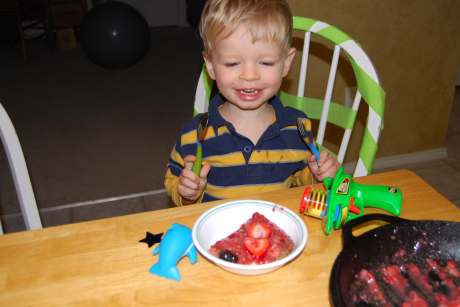
 Pardon the delay, I’m quite behind. Jordan turned 3 the beginning of
March. It was a very significant day for me. A day we didn’t know if he
would survive long enough to see. Right around 1 year old, when he was
allergic to all food except sweet potato (and so bored with it after
months of it breakfast, lunch, and dinner that he threw more of it at me
than he ate) and my milk just wasn’t meeting all of his needs any more,
we were told by the doctor and allergists, that they couldn’t do
anything until he was three. My response, “THREE???? He can’t eat
anything, he’s not going to live until three at this rate.” He had
fallen from the 90th percentile on height to the 50th percentile, and
his weight had fallen to the 5th percentile – not good, but not
surprising.
Pardon the delay, I’m quite behind. Jordan turned 3 the beginning of
March. It was a very significant day for me. A day we didn’t know if he
would survive long enough to see. Right around 1 year old, when he was
allergic to all food except sweet potato (and so bored with it after
months of it breakfast, lunch, and dinner that he threw more of it at me
than he ate) and my milk just wasn’t meeting all of his needs any more,
we were told by the doctor and allergists, that they couldn’t do
anything until he was three. My response, “THREE???? He can’t eat
anything, he’s not going to live until three at this rate.” He had
fallen from the 90th percentile on height to the 50th percentile, and
his weight had fallen to the 5th percentile – not good, but not
surprising.